Tell us about the job
Takes about a minute. No obligation.
A furnace repair in Wheeler County starts at the burner and ignition system, because that is where the load lands. Homes in Wheeler County, OR run heat about ten months a year, from September through June. Cycling that many months grinds down igniters, stresses heat exchangers, and pushes burners through far more on-off cycles than the rest of the equipment sees. A contractor who opens the cabinet here expects to find wear on those parts and prices the job accordingly. Ductwork and filters wait; the combustion side does not.
Furnace repair in Wheeler County runs into a specific problem once a system is opened: parts for equipment that old are no longer in every distributor's catalog, and a contractor who finds a cracked heat exchanger or a failed burner assembly has to confirm availability before a repair scope makes sense. Half the homes in Wheeler County, Oregon were built in 1975 or earlier (2020-2024 ACS 5-year). That proportion of the housing stock means a contractor here encounters furnaces that have logged far more heating seasons than a unit installed recently, and the condition of what is inside the cabinet reflects it. A heat exchanger that has expanded and contracted through that many winters cracks in ways that are not visible from outside, and that finding changes both the part ordered and the bill.
The Parts of a Furnace a Contractor Checks First
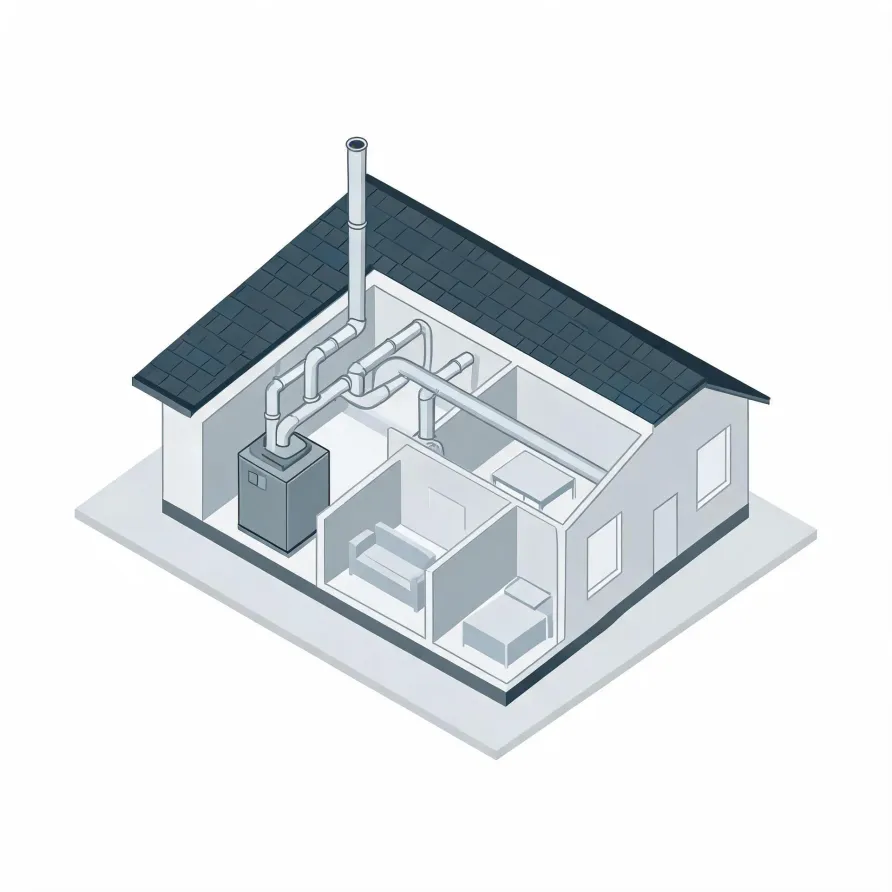
The furnace itself sits in a utility room, basement, or closet and is the piece a contractor goes to first. Inside it, the heat exchanger is the part most worth understanding: it separates combustion gases from the air your family breathes, and a crack there is a serious fault. The burners, which fire the heat, and the igniter, which starts them, are the other components that draw early attention when a furnace stops producing heat.
The blower motor sits at the base of the furnace cabinet and pushes conditioned air out through the house. The flue pipe runs from the furnace to an outside vent and carries combustion exhaust away. The control board ties everything together, reading signals from the thermostat and telling each component when to act, so a fault there can look like almost anything else has failed.
The drawing shows the general layout of a furnace system, and a licensed contractor determines which parts apply to your specific house and situation.
Get matched in Wheeler CountyWheeler County by the numbers
98 severe weather events were recorded in Wheeler County, Oregon between 2015 and 2024.
NOAA National Centers for Environmental Information, Storm Events Database, bulk CSV export, events 2015-01-01 through 2024-12-31.Half the homes in Wheeler County, Oregon were built in 1975 or earlier (2020-2024 ACS 5-year).
U.S. Census Bureau, 2020-2024 American Community Survey 5-Year EstimatesWheeler County, Oregon holds 908 housing units (2020-2024 ACS 5-year).
U.S. Census Bureau, 2020-2024 American Community Survey 5-Year EstimatesOwners occupy 71.8% of the occupied homes in Wheeler County, Oregon (2020-2024 ACS 5-year).
U.S. Census Bureau, 2020-2024 American Community Survey 5-Year EstimatesCodes & Standards Governing Furnace Repair in Wheeler County, Oregon6 sourced rules and standards
What the repair visit looks like
Non-weatherized gas furnaces manufactured on or after November 19, 2015 must reach 80.0 percent AFUE.
Non-weatherized oil-fired furnaces manufactured on or after November 19, 2015 must reach 83.0 percent AFUE.
Mobile home gas furnaces manufactured on or after November 19, 2015 must reach 80.0 percent AFUE.
Non-weatherized gas furnaces manufactured on or after December 18, 2028 must reach 95.0 percent AFUE, up from the 80.0 percent minimum that applies to units manufactured before that date.
Licensing and Legal Requirements in Wheeler County, Oregon
Oregon’s contractor licence does not reach casual, minor or inconsequential work on one structure where the person’s contracts total less than $1,000 — and the exemption is unavailable to anyone who advertises or signs themselves as a contractor, at any price.
Oregon requires a current Construction Contractors Board licence, with the right endorsement, to undertake, offer to undertake or bid construction work.
Weather Stress on Heating Equipment in Wheeler County
Furnaces in Wheeler County work against whatever the local climate demands of them, and that load shows up over time as wear, strain, and repair calls. Tracking severe weather events year by year puts a number to what equipment here is actually asked to handle.
98 severe weather events, 2015–2024. Source: NOAA National Centers for Environmental Information, Storm Events Database.