Tell us about the job
Takes about a minute. No obligation.
A contractor called out to repair a furnace in Josephine County starts with the ignition system and the heat exchanger, because those are the components that cycle every time the furnace fires. Homes in Josephine County, OR run heat about nine months a year, from October through June. The burner and igniter take the brunt of that workload, and by the time a homeowner notices a fault, the ignition system has usually been struggling for a while. Cracks in the heat exchanger or a degraded flame sensor are common findings here precisely because the equipment does not get the idle time that would let a marginal part limp along unnoticed.
Ductwork running through houses this old was sized and routed for the original equipment, and the furnace that replaced it was adapted to fit what was already there. Half the homes in Josephine County, Oregon were built in 1982 or earlier (2020-2024 ACS 5-year). That history matters when a contractor opens a furnace for repair: heat exchangers crack in specific ways, burner assemblies wear in patterns tied to how long a system has been cycling, and parts for equipment that old sit at the edge of what distributors still stock. A repair that looks straightforward from the outside can stall on a component that takes days to source or no longer ships at all.
The Parts of a Furnace a Contractor Checks First
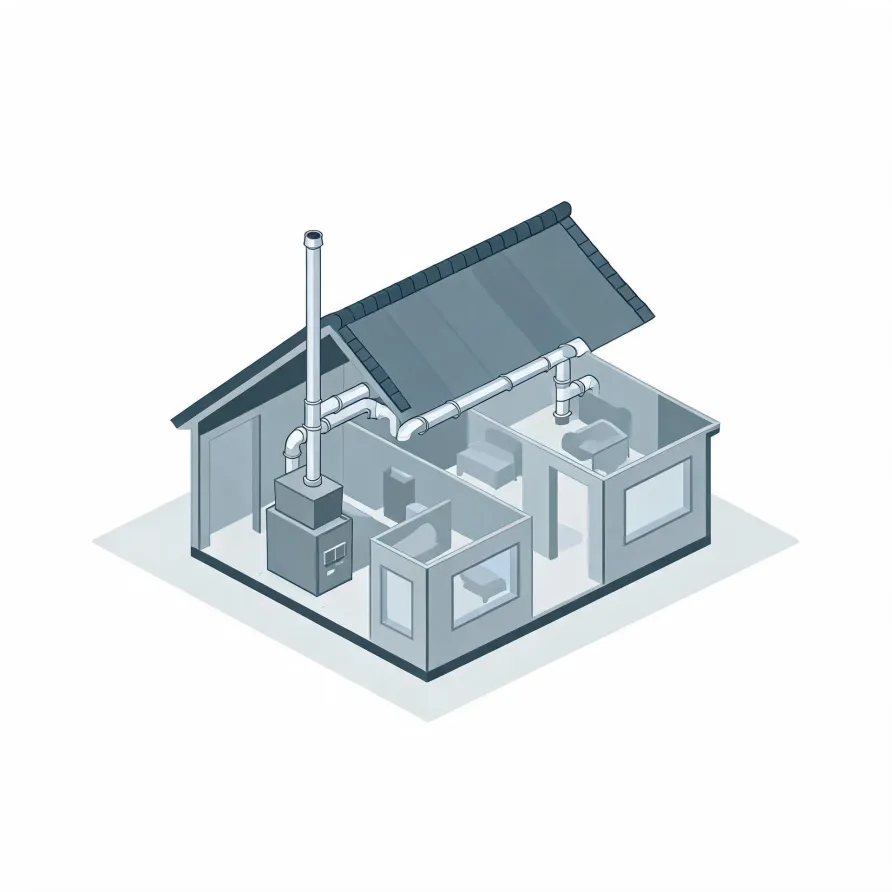
The furnace itself sits in a utility room, basement, or closet and is the piece a contractor goes to first. Inside it, the heat exchanger is what actually warms the air, and a crack or breach there is serious. The burners feed flame into that exchanger, and when a furnace runs poorly or not at all, the burners and the exchanger are where the diagnosis often starts.
The blower motor sits inside the furnace cabinet and pushes conditioned air through the house. The flue pipe runs from the cabinet up and out of the building, carrying combustion gases away. The control board ties all of it together, reading sensors and telling each part when to run, so a fault there can look like a fault anywhere else in the system.
The drawing shows a typical furnace layout, and a licensed contractor determines what applies to your specific installation.
Get matched in Josephine CountyJosephine County, by the numbers
91 severe weather events were recorded in Josephine County, Oregon between 2015 and 2024.
NOAA National Centers for Environmental Information, Storm Events Database, bulk CSV export, events 2015-01-01 through 2024-12-31.Half the homes in Josephine County, Oregon were built in 1982 or earlier (2020-2024 ACS 5-year).
U.S. Census Bureau, 2020-2024 American Community Survey 5-Year EstimatesJosephine County, Oregon holds 39,503 housing units (2020-2024 ACS 5-year).
U.S. Census Bureau, 2020-2024 American Community Survey 5-Year EstimatesOwners occupy 71.7% of the occupied homes in Josephine County, Oregon (2020-2024 ACS 5-year).
U.S. Census Bureau, 2020-2024 American Community Survey 5-Year EstimatesCodes & Standards Covering Furnace Repair in Josephine County, Oregon6 sourced rules & standards
What HVAC Repair Looks Like in Josephine County
Non-weatherized gas furnaces manufactured on or after November 19, 2015 must reach 80.0 percent AFUE.
Non-weatherized oil-fired furnaces manufactured on or after November 19, 2015 must reach 83.0 percent AFUE.
Mobile home gas furnaces manufactured on or after November 19, 2015 must reach 80.0 percent AFUE.
Non-weatherized gas furnaces manufactured on or after December 18, 2028 must reach 95.0 percent AFUE, up from the 80.0 percent minimum that applies to units manufactured before that date.
Licensing Rules for HVAC Repair in Josephine County, Oregon
Oregon’s contractor licence does not reach casual, minor or inconsequential work on one structure where the person’s contracts total less than $1,000 — and the exemption is unavailable to anyone who advertises or signs themselves as a contractor, at any price.
Oregon requires a current Construction Contractors Board licence, with the right endorsement, to undertake, offer to undertake or bid construction work.
Weather That Works Against Heating Equipment in Josephine County
Furnaces in Josephine County run harder and fail faster when the weather turns harsh. That wear is local, and so is the repair work it generates.
91 severe weather events, 2015–2024. Source: NOAA National Centers for Environmental Information, Storm Events Database.