Tell us about the job
Takes about a minute. No obligation.
A furnace repair quote in Lane County starts with the burner assembly and heat exchanger, because those are the parts that have been cycling the longest. Homes in Lane County, OR run heat about ten months a year, from September through June. That kind of continuous seasonal demand cracks heat exchangers, wears ignition components, and degrades burner performance in ways that show up as repair calls rather than gradual decline. A contractor who skips a close inspection of those parts before pricing a fix is likely to miss the actual failure point.
Furnaces in a house old enough to predate the equipment now running in it tend to carry components that suppliers have quietly stopped stocking. Half the homes in Lane County, Oregon were built in 1977 or earlier (2020-2024 ACS 5-year). A contractor opening a furnace here has to identify the part, trace whether it is still made, and find a source before any repair price means anything. Heat exchangers, control boards, and burner assemblies from older residential systems often sit outside current supply chains, which changes both what the repair costs and how long it takes. That is what shapes the job.
The Parts of a Furnace a Contractor Checks First
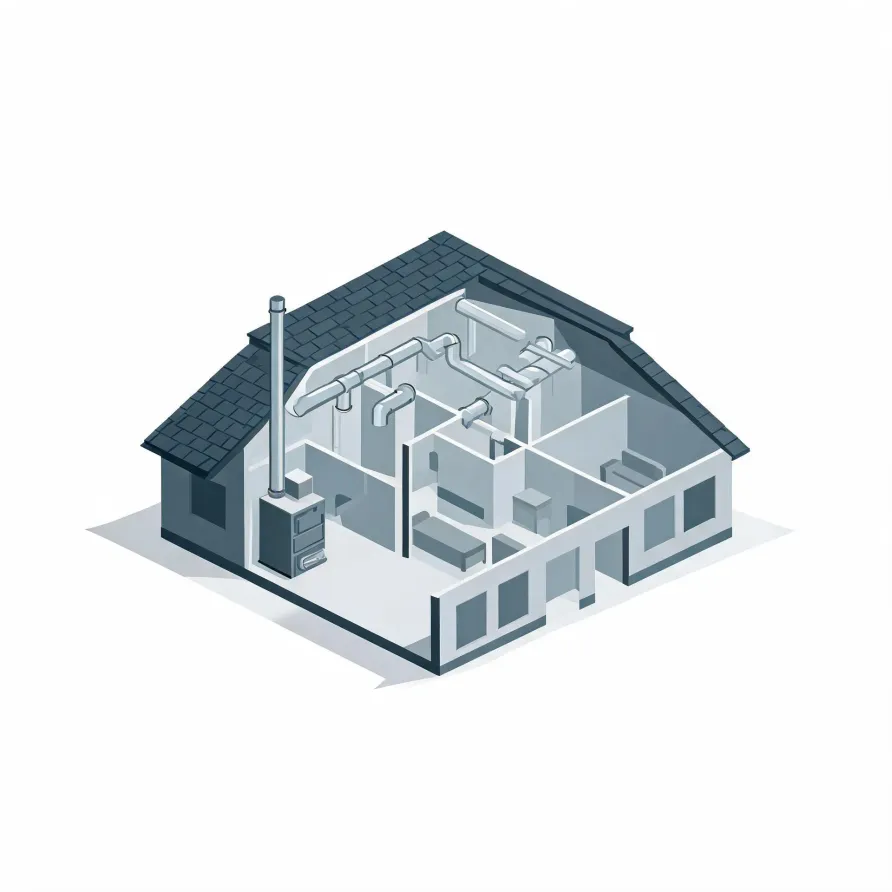
The furnace itself sits in a utility room, basement, or closet and is the piece a contractor goes to first. Inside it, the heat exchanger does the work of warming air, and a cracked or corroded exchanger is one of the most serious faults a technician looks for. The burner assembly, which produces the flame, and the igniter, which starts it, are early suspects when a furnace fails to fire.
The blower motor pushes conditioned air into the duct system and draws return air back through the filter. A failing motor may run weakly, overheat, or stop entirely. The flue pipe carries combustion gases out of the house, and a contractor checks it alongside the heat exchanger whenever combustion problems are on the table.
The drawing shows a typical furnace layout, and a licensed contractor determines which components apply to your specific system and situation.
Get matched in Lane CountyLane County, by the numbers
20 severe weather events were recorded in Lane County, Oregon between 2015 and 2024.
NOAA National Centers for Environmental Information, Storm Events Database, bulk CSV export, events 2015-01-01 through 2024-12-31.Half the homes in Lane County, Oregon were built in 1977 or earlier (2020-2024 ACS 5-year).
U.S. Census Bureau, 2020-2024 American Community Survey 5-Year EstimatesLane County, Oregon holds 169,788 housing units (2020-2024 ACS 5-year).
U.S. Census Bureau, 2020-2024 American Community Survey 5-Year EstimatesOwners occupy 59.7% of the occupied homes in Lane County, Oregon (2020-2024 ACS 5-year).
U.S. Census Bureau, 2020-2024 American Community Survey 5-Year EstimatesCodes & Standards Governing Furnace Repair in Lane County, Oregon6 sourced rules and standards
What the repair visit looks like
Non-weatherized gas furnaces manufactured on or after November 19, 2015 must reach 80.0 percent AFUE.
Non-weatherized oil-fired furnaces manufactured on or after November 19, 2015 must reach 83.0 percent AFUE.
Mobile home gas furnaces manufactured on or after November 19, 2015 must reach 80.0 percent AFUE.
Non-weatherized gas furnaces manufactured on or after December 18, 2028 must reach 95.0 percent AFUE, up from the 80.0 percent minimum that applies to units manufactured before that date.
Licensing and Legal Requirements in Lane County, Oregon
Oregon’s contractor licence does not reach casual, minor or inconsequential work on one structure where the person’s contracts total less than $1,000 — and the exemption is unavailable to anyone who advertises or signs themselves as a contractor, at any price.
Oregon requires a current Construction Contractors Board licence, with the right endorsement, to undertake, offer to undertake or bid construction work.