Tell us about the job
Takes about a minute. No obligation.
Sizing a furnace for a Wallowa County home is not a calculation a contractor can borrow from somewhere else. Homes in Wallowa County, OR run heat about ten months a year, from September through June. The burner, heat exchanger, and ignition system cycle through that span with little idle time to recover, so undersizing or a loose installation shows up in those components first. A contractor working a quote here has to establish actual heat loss for the house before any equipment gets specified, because a unit that fits the load in a milder climate will run harder and longer here and reach its limits sooner.
Ductwork sized and routed for equipment that is no longer in these houses is what a furnace installation turns on. Half the homes in Wallowa County, Oregon were built in 1973 or earlier (2020-2024 ACS 5-year). That history means the ducts a contractor finds are shaped around load calculations done for something older, and whether those runs deliver what a new furnace needs is a question the house itself has to answer. Electrical service matters too, but duct fit is where the real variation lives from job to job.
What Gets Installed With a New Furnace
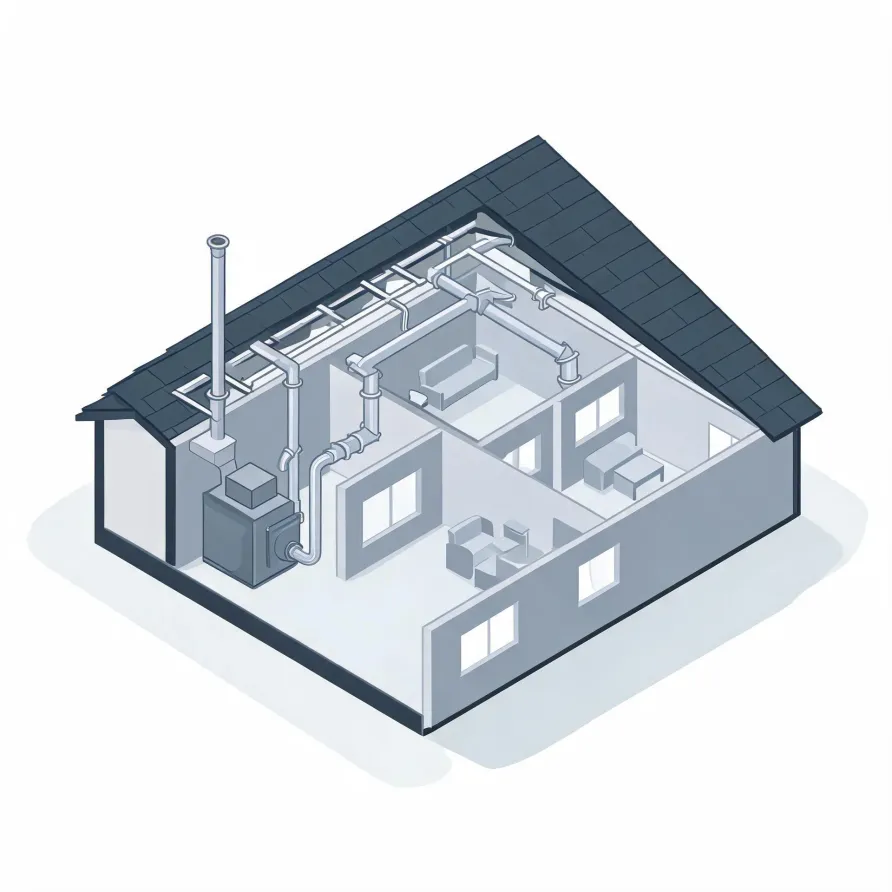
The furnace itself sits in a utility room, basement, or garage and is the unit a homeowner sees when they look at the heating system. A contractor mounts the air handler inside this cabinet, which pulls in household air, conditions it, and pushes it back out. The flue pipe runs from the cabinet up and out of the house, carrying combustion exhaust away.
The thermostat goes on a main living-area wall and is the control point the household uses every day. A contractor also installs or connects the filter housing at the furnace's air intake, and fits the plenum, the short metal box that transitions the furnace to the supply and return duct runs above or around it.
The drawing beside this text shows a typical layout, and a licensed contractor will assess what the configuration looks like in your specific home.
Get matched in Wallowa CountyWallowa County, by the record
85 severe weather events were recorded in Wallowa County, Oregon between 2015 and 2024.
NOAA National Centers for Environmental Information, Storm Events Database, bulk CSV export, events 2015-01-01 through 2024-12-31.Half the homes in Wallowa County, Oregon were built in 1973 or earlier (2020-2024 ACS 5-year).
U.S. Census Bureau, 2020-2024 American Community Survey 5-Year EstimatesWallowa County, Oregon holds 4,349 housing units (2020-2024 ACS 5-year).
U.S. Census Bureau, 2020-2024 American Community Survey 5-Year EstimatesOwners occupy 72.5% of the occupied homes in Wallowa County, Oregon (2020-2024 ACS 5-year).
U.S. Census Bureau, 2020-2024 American Community Survey 5-Year EstimatesFurnace Installation Rules for Wallowa County, Oregon6 codes, standards & laws
What happens when the contractor comes out
Non-weatherized gas furnaces manufactured on or after November 19, 2015 must reach 80.0 percent AFUE.
Non-weatherized oil-fired furnaces manufactured on or after November 19, 2015 must reach 83.0 percent AFUE.
Mobile home gas furnaces manufactured on or after November 19, 2015 must reach 80.0 percent AFUE.
Non-weatherized gas furnaces manufactured on or after December 18, 2028 must reach 95.0 percent AFUE, up from the 80.0 percent minimum that applies to units manufactured before that date.
Licensing and Legal Requirements in Wallowa County, Oregon
Oregon’s contractor licence does not reach casual, minor or inconsequential work on one structure where the person’s contracts total less than $1,000 — and the exemption is unavailable to anyone who advertises or signs themselves as a contractor, at any price.
Oregon requires a current Construction Contractors Board licence, with the right endorsement, to undertake, offer to undertake or bid construction work.
Severe Weather Events in Wallowa County
Weather in Wallowa County puts real demands on heating equipment, from how hard a furnace has to work to how long it runs before relief arrives. That workload shapes what equipment a home needs and how it should be installed.
85 severe weather events, 2015–2024. Source: NOAA National Centers for Environmental Information, Storm Events Database.